
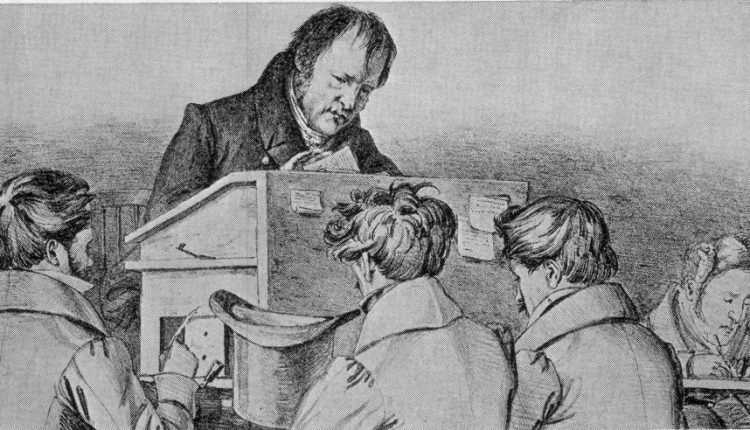
It is perhaps surprising to claim that the master of abstruse German philosophy and dialectical logic might be thought to have a practical theory of the workings of government. But in fact, Hegel’s Philosophy of Right contains some ideas that look a lot like such a theory. For Hegel discusses not merely the authority and role of the state within society, but he also discusses the nature and challenges of state administration — including in particular its need for organized processes and people through which the will and projects of the state are carried out. He considers the need for division of function; selection and training of staff; the crucial separation between personal interests and public interests; and other challenges to the workings of government.
Consider a series of passages from Part 3, Section 3: The State, with my summary comments in bold.
Government requires organized processes and staff to carry out its will. Hegel places the responsibility for implementing the state’s actions with the executive function of the state:
The execution and application of the sovereign’s decisions, and in general the continued implementation and upholding of earlier decisions, existing laws, institutions, and arrangements to promote common ends, etc., are distinct from the decisions themselves. This task of subsumption in general belongs to the executive power, which also includes the powers of the judiciary and the police; these have more immediate reference to the particular affairs of civil society, and they assert the universal interest within these [particular] ends. (§ 287)
The work of government proceeds through expert professional civil servants under the authority of higher-level executives:
The task of upholding, within these particular rights, legality and the universal interest of the state, and that of bringing these rights back to the universal, need to be performed by delegates of the executive power, i.e. the executive civil servants and the higher consultative bodies. The latter necessarily work together in groups, and they converge in their supreme heads who are in touch with the monarch himself. § 289
Administrative action and decision-making is often rendered “inept” by the fact of incomplete knowledge of the state’s plans and goals on the part of senior “supervisors”:
The administration of a corporation’s affairs by its own supervisors will often be inept, for although they know and have before them their own distinct interests and affairs, they have a less complete grasp of the connection between these and more remote conditions and universal points of view. Besides, further circumstances have a similar effect, e.g. the close personal contact and other kinds of equality between the supervisors and those who should be subordinate to them, the various ways in which they are dependent on others, etc. § 289
The state’s apparatus requires a logical division of responsibilities and tasks, with separate “centers” assigned to performance of a range of sub-tasks. But once divided, there is a perennial risk of a failure for the activities of various centers to reassemble in a consistent way:
The organization of official bodies accordingly faces the formal but difficult task of ensuring that civil life shall be governed in a concrete manner from below, where it is concrete, but that the business in question shall be divided into its abstract branches and dealt with by distinct bodies; the latter should function as separate centres whose activities should again converge both at the lowest level and in a concrete overview on the part of the supreme executive. § 290
The most important issue for the executive power is the division of functions. The executive power is concerned with the transition from the universal to the particular and individual, and its functions must be divided in accordance with its different branches. The difficulty, however, is [that of ensuring] that they also come together again at upper and lower levels. For although the power of the police and that of the judiciary, for example, are divergent, they do converge in every particular case. § 290
There are mechanisms for enforcing unity of government action — for example, by appointing a “chief operating officer” (prime minister) who oversees the workings of the sub-groups. But this raises the risk of re-creating centralized decision-making:
The expedient which is often employed in these circumstances is to appoint a State Chancellor, Prime Minister, or Cabinet Council in order to simplify the highest level of government. But this may have the result that everything is again controlled from above by ministerial power, and that functions are, to use the common expression, centralized. This is associated with a high degree of facility, speed, and effectiveness in measures adopted for the universal interest of the state. A regime of this kind was introduced by the French Revolution and further developed by Napoleon, and it still exists in France today. On the other hand, France lacks corporations and communal associations — that is, circles in which particular and universal interests come together. Admittedly, these circles gained too great a degree of self-sufficiency in the Middle Ages, when they became states within the state and behaved in an obdurate manner like independently established bodies. But although this ought not to happen, it can still be argued that the proper strength of states resides in their [internal] communities. In these, the executive encounters legitimate interests which it must respect; and since the administration can only encourage such interests — although it must also supervise them — the individual finds protection for the exercise of his rights, so that his particular interest is bound up with the preservation of the whole. For some time now, organization has always been directed from above, and efforts have been devoted for the most part to this kind of organization, despite the fact that the lower level of the masses as a whole can easily be left in a more or less disorganized state. Yet it is extremely important that the masses should be organized, because only then do they constitute a power or force; otherwise, they are merely an aggregate, a collection of scattered atoms. Legitimate power is to be found only when the particular spheres are organized. § 290
The staff of government — executives and managers — should be selected on the basis of qualifications and ability.
The functions of the executive are objective in character; as such, they have already been substantially decided in advance (see § 287), and they must be fulfilled and actualized by individuals. Individuals are not destined by birth or personal nature to hold a particular office, for there is no immediate and natural link between the two. The objective moment in their vocation is knowledge and proof of ability; this proof guarantees that the needs of the state will be met, and, as the sole condition [of appointment], at the same time guarantees every citizen the possibility of joining the universal estate. § 291
There is the possibility that staff and executives will mix their personal and official duties and interests. To avoid this possibility, the compensation for official duties should be generous:
The individual who has been appointed to his professional office by an act of the sovereign (see § 292) must fulfil his duties, which are the substantial aspect of his position, as a condition of his appointment. As a consequence of this substantial position, his appointment provides him with resources, guarantees the satisfaction of his particularity (see § 264), and frees his external situation and official activity from other kinds of subjective dependence and influence. § 294
The state cannot rely on pure self-interest on the part of its agents (“knights errant”). Instead, it needs to recruit “civil servants” who will place their official duties at the center of their commitment and action.
The state does not count on arbitrary and discretionary services (for example, the administration of justice by knights errant), precisely because such services are discretionary and arbitrary, and because those who perform them reserve the right to do so in accordance with their subjective views, or not to perform them at all if they so wish and to pursue subjective ends instead. As regards the service of the state, the opposite extreme to the knight errant would be a civil servant who performed his work purely out of necessity [Not] without any genuine duty and likewise without any right. — In fact, the service of the state requires those who perform it to sacrifice the independent and discretionary satisfaction of their subjective ends, and thereby gives them the right to find their satisfaction in the performance of their duties, and in this alone. It is here that, in the present context, that link is to be found between universal and particular interests which constitutes the concept of the state and its internal stability (see § 260). § 294
Misuse of power is always a possibility. Executives have the responsibility to prevent misuse; but the organizations of civil society can do so as well:
The protection of the state and the governed against the misuse of power on the part of the official bodies and their members is, on the one hand, the direct responsibility of their own hierarchy; on the other hand, it lies with the legal recognition accorded to communities and corporations, for this prevents subjective arbitrariness from interfering on its own account with the power entrusted to officials, and supplements from below that control from above which does not extend as far as individual conduct. § 295
A key feature of “correct performance” by executives and staff of the state is the availability of effective moral and professional training:
Whether or not dispassionateness, integrity, and polite behaviour become customary will depend in part on direct education in ethics and in thought, for this provides a spiritual counterweight to the mechanical exercises and the like which are inherent in learning the so-called sciences appropriate to these [administrative] spheres, in the required business training, in the actual work itself, etc. But the size of the state is also an important consideration, for it both reduces the burden of family ties and other private commitments and lessens the power — and thereby takes the edge off — such passions as revenge, hatred, etc. These subjective aspects disappear of their own accord in those who are occupied with the larger interests of a major state, for they become accustomed to dealing with universal interests, views, and functions. § 296
These passages are very interesting, because they contain the germ of an organizational theory of government and an actor-centered approach to the workings of government. Hegel seems to be aware of the deep challenge presented by separation of interest between organization and employee — the principal-agent problem; he seems to recognize the possibility of government dysfunction; and he offers some theories about how to neutralize these harmful possibilities within government. It might even be said that he has the main elements of a theory of rational bureaucracy, a century before Weber treated the concept as a sociologist.
I do not put forward this example to suggest that philosophical study of government should start with Hegel, or that Hegel’s organizational insights are especially deep. I simply find it interesting that Hegel had any views on the matter at all.

 A Philosophy of Government